

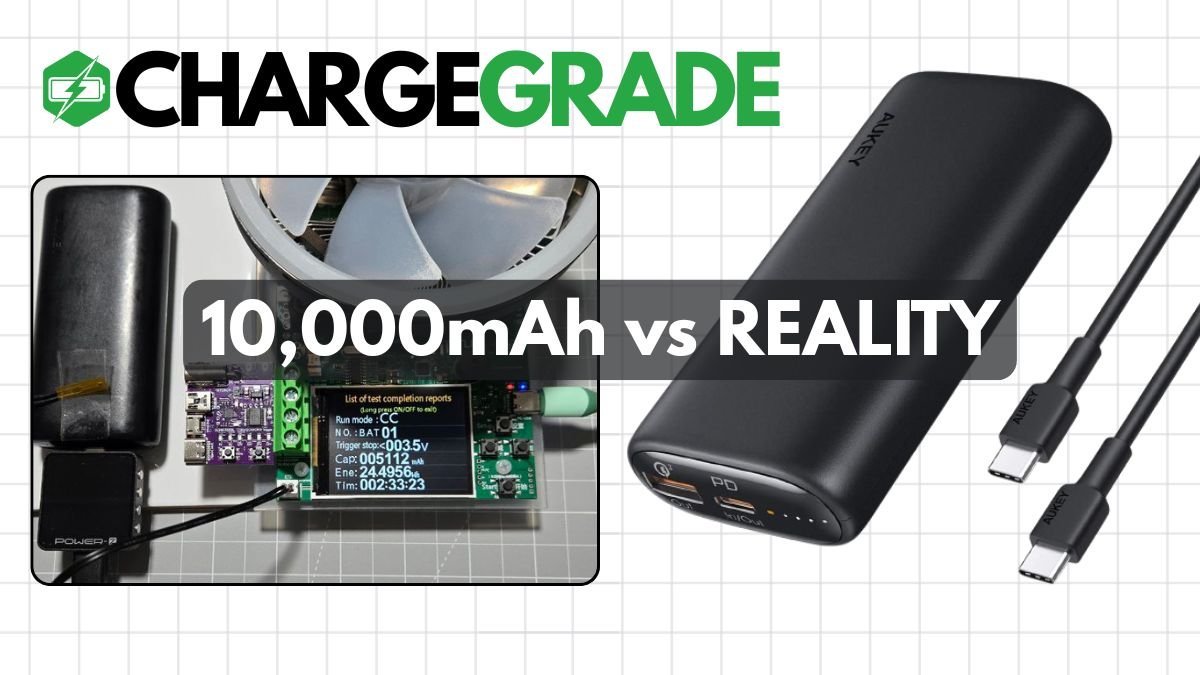
A case study in battery aging. Not recommended for purchase in 2026.
Pros
- Good build quality (lasted 5 years)
- Pass-through charging supported
- Low-current mode works well
Cons
- Significant battery degradation (66% efficiency)
- Slow 18W charging (No PPS)
- Slow 3.5h recharge time
-
Efficiency
-
Portability
-
Build Quality
-
Value
-
Power Performance
Why Your “10,000mAh” Power Bank Only Charges Your Phone Twice
Today, we aren’t reviewing a brand-new flagship device. Instead, we are taking a veteran Aukey PB-Y36S—a power bank that has seen 5 years of use—and putting it on our test bench. Why test an old device? To demonstrate exactly how marketing specs mislead consumers, and to show you exactly how a real power bank capacity (lithium-ion cells) degrade over time.
If you buy a carton of milk, you get 1 liter. But if you buy a power bank, the number on the box is almost always a lie.
Table of Contents
The Science: Why “10,000mAh” is a Myth
Before we get to the test results, we need to clear up the biggest misconception in the industry: Watt-Hours (Wh) vs. Milliamp-Hours (mAh).
Manufacturers list capacity in mAh based on the internal battery voltage of 3.6/3.7V. However, your phone charges at 5V (USB standard) or higher. To bridge that gap, the power bank has to boost the voltage. This process burns energy as heat.
- The Math: 10,000mAh * 3.7V / 1,000 = 37.0 Watt-Hours (Wh).
- The Reality: Even a perfect, brand-new power bank is usually only ~85% efficient. The theoretical max you can ever get from a “10,000mAh” bank is roughly 31.5Wh.
If you get less than that, the battery is either low quality, lying about specs, or degraded.
Lab Test 1: The Capacity Audit (Efficiency)
We connected the Aukey PB-Y36 to our Programmable DC Electronic Load and subjected it to our standard Testing Protocol at 10W. The reason for that is that If you plug a modern phone into a high-tech power bank using an old or damaged cable, the digital handshake often fails. The system defaults to the safe USB-BC 1.2 standard, which is capped at roughly 12W. We test how the bank performs when high-speed tech fails.
- Load: Constant Current (CC) at 2.0A / 5V (10W).
- Temperature: 25°C ambient.
- Goal: Drain from 100% to 0% cutoff.
After 5 hours of draining, the results were stark.
Test Protocol:
- Load: Constant Current (CC) at 2.0A / 5V (10W).
- Temperature: 25°C ambient.
- Goal: Drain from 100% to 0% cutoff.
| Metric | Rated | Lab Measured |
| Capacity (Wh) | 37.0 Wh | 24.5 Wh |
| Capacity (mAh @ 5V) | 10,000mAh | 5,112 mAh |
| Efficiency Score | 100% (Theoretical) | 66.2% |
The Analysis
A 66.2% efficiency score truly shows the effects of time on this device.
Does this mean Aukey makes bad products? No.
It means Time is undefeated. Lithium-ion batteries degrade chemically with every charge cycle. This unit has lost nearly 20% of its original health over 5 years.
While it still “works,” this is now effectively a 6,500mAh power bank disguised in a 10,000mAh shell. It is carrying dead weight.
- Claimed Energy: 37.0 Wh
- Measured Energy: 24.5 Wh
- Total Efficiency: 66.2%
The Verdict:
This power bank has lost nearly 20% of its original chemical health purely due to age. This assumes that a good quality real world has 85% or more efficiency. While it still “works,” it is now effectively a 6,500mAh power bank disguised in a 10,000mAh shell.
Lab Test 2: Output & Compatibility
We used our Precision Protocol Analyzer to see if this older unit can keep up with modern 2026 smartphones.
- USB-C Output: PD 3.0 (18W Max)
- USB-A Output: QC 3.0
- Samsung PPS: Fail (Not Supported)
What this means for you:
If you have an iPhone 15/16/17 or a Samsung Galaxy, this power bank will charge them, but slowly. It lacks PPS (Programmable Power Supply), which is required for Samsung’s “Super Fast Charging.” It is capped at 20W, whereas modern phones can accept 25W–45W.
Lab Test 3: User Experience
We tested the “Quality of Life” features that specs don’t show.
- Pass-Through Charging: PASS. We confirmed the unit can charge a phone while being recharged from the wall.
- Low Current Mode: PASS. Holding the power button for 2 seconds enters a special mode for earbuds/smartwatches.
- Recharge Speed: FAIL. It took 3.5 hours to recharge this unit. In an era where 10,000mAh banks can recharge in 90 minutes, this shows its age.
The Verdict: Time to Retire
This test validates why ChargeGrade exists. Marketing specs are permanent, but battery chemistry is temporary.
If you are still carrying a power bank from 2020, you are likely carrying 30% dead weight. This Aukey PB-Y36 was a solid performer in its day, but with an efficiency of 66% and a lack of modern PPS charging, it has reached the end of its useful life.
What Should You Buy Instead?
We have just acquired the latest Anker, Ugreen, and Cuktech power banks. We are putting them on the bench this week to see which ones are telling the truth, and which ones are burning your money.