

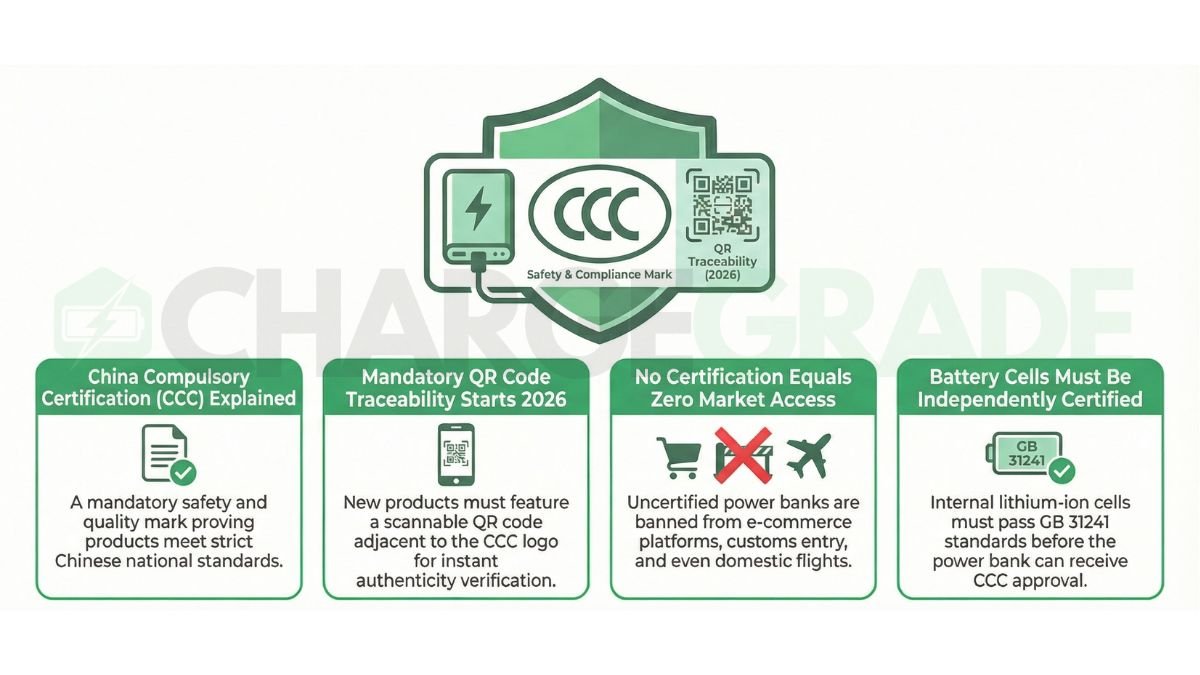
If you have purchased a portable charger recently, or if you are planning to travel through Asia with your electronics, you may have noticed a small, oval symbol on your device: the CCC mark. But what is CCC in powerbank terminology, and why should it determine whether you buy a device or leave it on the shelf?
For years, the market was flooded with cheap, unregulated battery packs that posed significant fire risks. In response, regulatory authorities have implemented some of the strictest safety standards in the world. As of 2025, understanding CCC in powerbank safety is no longer just for manufacturers. It is essential knowledge for consumers to ensure they are carrying a safe device that won’t be confiscated at airport security.
This guide will explain exactly what this certification means, the “torture tests” these devices must survive, and the new digital tracking laws taking effect in 2026.
So what’s CCC in Powerbank?
CCC stands for China Compulsory Certification (often referred to as “3C”). It is a statutory compulsory safety certification system implemented to protect national security, human health, electromagnetic compatibility, and quality criteria.
When we ask what is CCC in powerbank contexts, we are referring to the specific inclusion of “mobile power supplies” (Product Code 0914) into this mandatory safety catalogue
Any power bank legally sold in China must carry this mark, proving it has passed an extensive matrix of laboratory tests and manufacturing audits. It’s the Chinese equivalent of both the UL (North America) and CE (Europe) marks combined, only stricter in some areas.
Think of it as your power bank’s personal safety diploma, earned after a surprisingly harsh graduation exam.
If a power bank is to be sold in China, it must carry this mark. It’s like a passport for electronics entering the Chinese market. No CCC, No sale.
Why the CCC Exists (And Why Power Banks Must Pass)
At its core, CCC aims to make sure that electrical products don’t catch fire, explode, or interfere with other devices. For portable energy storage devices like power banks which carry lithium‑ion cells inside a tiny case, this oversight isn’t optional; it’s life‑saving.
Digging Deeper
Before CCC existed, multiple agencies issued overlapping approvals, confusing both manufacturers and consumers. In 2002, China unified these requirements into a single, state‑supervised system: the CCC.
For power banks, the certification ensures:
- Electrical safety: No risk of shock or overheating under normal use.
- Battery safety: Resistance to overcharge, short circuit, and internal thermal runaway.
- Environmental reliability: Stable operation in temperature extremes and humidity.
- Electromagnetic compatibility (EMC): No harmful interference with other electronics.
Only after a product passes these hurdles can it legally enter the Chinese market.
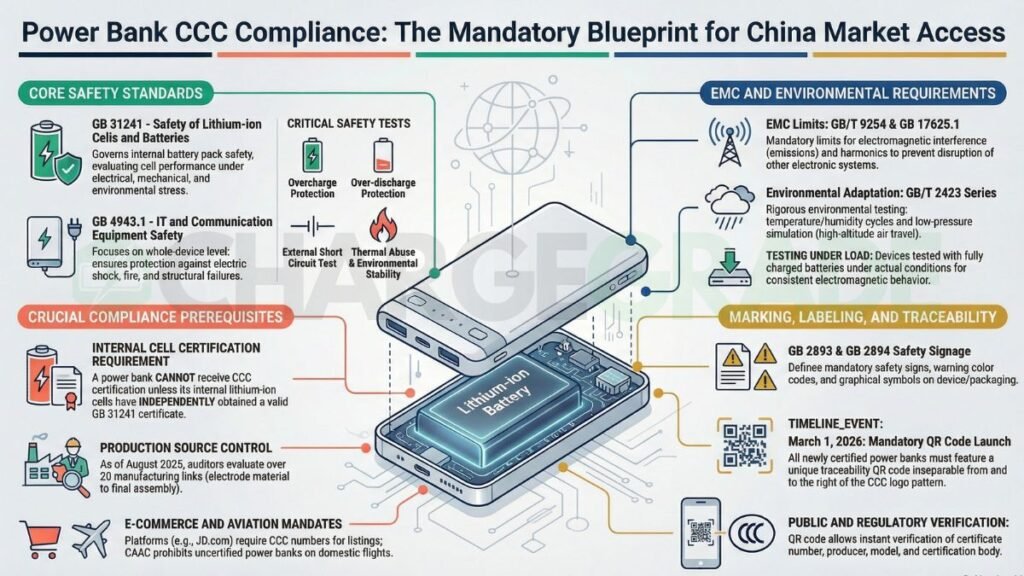
Key Chinese Standards Governing Power Bank CCC
| Domain | Standard Code | Description |
|---|---|---|
| Battery & Power Pack Safety | GB 31241 | Safety of lithium‑ion cells and batteries used in portable electronics |
| Charger Safety | GB 4943.1 | IT and communication equipment safety requirements |
| EMC (Emissions & Immunity) | GB/T 9254 / GB 17625.1 | Limits for electromagnetic interference and harmonics |
| Marking & Labeling | GB 2893 / GB 2894 | Safety signs and warning color codes |
| Environmental Adaptation | GB/T 2423 series | Environmental tests for electrical equipment |
The CCC certificate draws from these overlapping standards, meaning a compliant product has cleared an entire ecosystem of national expectations, not a single bureaucratic checkbox.
Major Tests Required for Power Bank CCC Certification
You might picture engineers in lab coats poking your power bank with multimeters and you wouldn’t be far off. But the real process is far more rigorous. Let’s scan through the family of tests your power bank must survive.
Electrical Safety Tests
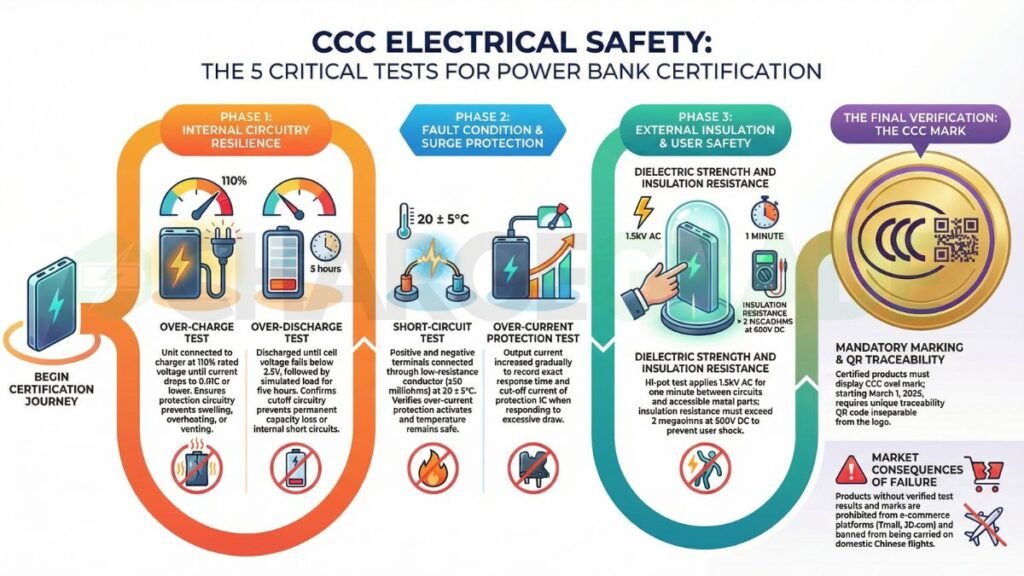
This is to ensure that the circuitry and insulation are robust.
| Test | Methodology | Purpose |
|---|---|---|
| Over‑charge test | The fully charged power bank is connected to a constant‑voltage charger 10 % above the rated voltage until the current drops to ≤ 0.01 C or until temperature stabilizes. | Ensures protection circuits stop charge current and prevent cell swelling or venting under excessive voltage. |
| Over‑discharge test | Unit discharged at 0.2 C until cell voltage < 2.5 V (cutoff). Then a simulated load continues discharge for an extra five hours. | Confirms cutoff circuitry prevents deep discharge damage leading to capacity loss or internal shorts. |
| Short‑circuit test | The positive and negative terminals of the pack are directly connected through a conductor ≤ 50 mΩ at 20 ± 5 °C until protection triggers or battery cools. | Verifies over‑current protection and temperature rise remain within safe limits. |
| Over‑current protection | The output is loaded gradually until protection circuitry disconnects. Current and cut‑off time are recorded. | Checks real‑time trip response of protection ICs. |
| Dielectric strength & insulation resistance | High‑potential (hi‑pot) test applies 1.5 kV AC for one minute between input/output and accessible metal parts; insulation resistance measured at 500 V DC must exceed 2 MΩ. | Confirms user cannot be shocked through enclosure. |
Battery Abuse and Mechanical Integrity Tests
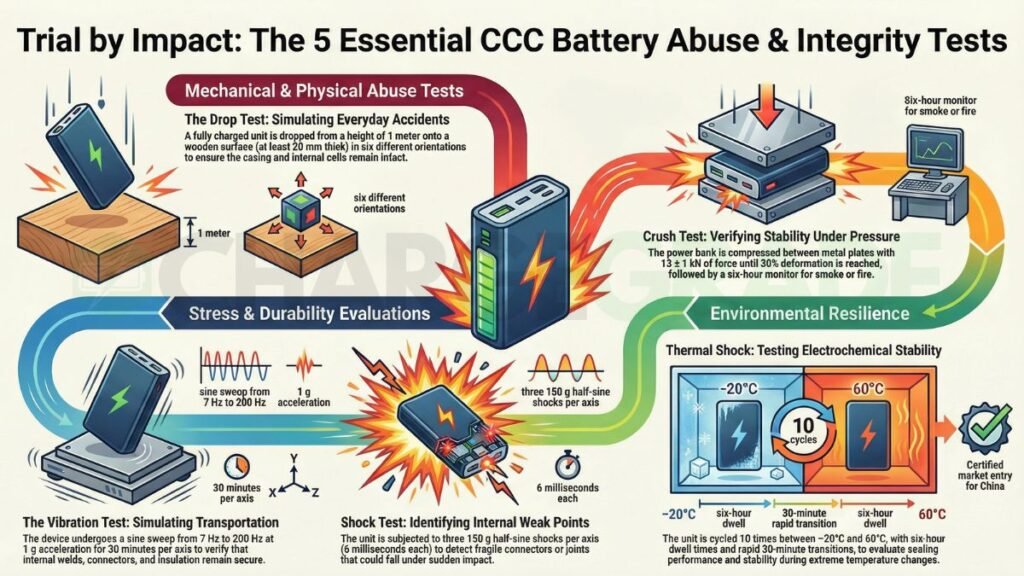
Because lithium‑ion cells can behave unpredictably, they endure “abuse” scenarios to prove their safety resilience.
| Test | Methodology | Purpose |
|---|---|---|
| Drop test | Fully charged unit dropped from 1 m height onto a wooden surface (thickness ≥ 20 mm) from each of six orientations. | Ensures casing and cells remain intact after everyday drops. |
| Crush test | Power bank placed between two flat metal plates; compressed at 13 ± 1 kN until deformation ≥ 30 % or force limit reached. Observed for smoke or fire for 6 h. | Confirms cells vent safely or remain stable under compression. |
| Vibration test | Sine sweep 7 Hz–200 Hz with 1 mm peak amplitude, 1 g acceleration, 30 min per axis. | Mimics transport vibrations; ensures welds, connectors, and insulation stay secure. |
| Shock test | Half‑sine waveform, 150 g for 6 ms, three shocks per axis. | Identifies weak internal joints and connector fragility. |
| Thermal shock | Alternating storage at −20 °C and 60 °C, each for 6 h, transition ≤ 30 min, 10 cycles. | Evaluates sealing performance and electrochemical resilience during sudden temperature changes. |
Environmental Tests
Power banks face extreme climates during shipping and user abuse.
| Test | Methodology | Purpose |
|---|---|---|
| High/low temperature storage | Kept at 60 ± 2 °C for 10 days then −20 ± 2 °C for 10 days. No deformation, leakage, or voltage loss > 10 % allowed. | Assures stability under warehouse and transport extremes. |
| Humidity test | 40 ± 2 °C at 90 % RH for 48 h, followed by functional test. | Detects corrosion or insulation degradation. |
| Altitude (low‑pressure) test | Stored in chamber at 11.6 kPa (≈ 15 000 m altitude) for 6 h at room temperature. | Simulates aircraft cargo hold conditions. Power bank must not leak or swell. |
| Salt‑mist/corrosion | 24 h in 5 % NaCl fog, followed by drying; contact resistance increase must be < 50 %. | Checks connector coatings and enclosure integrity. |
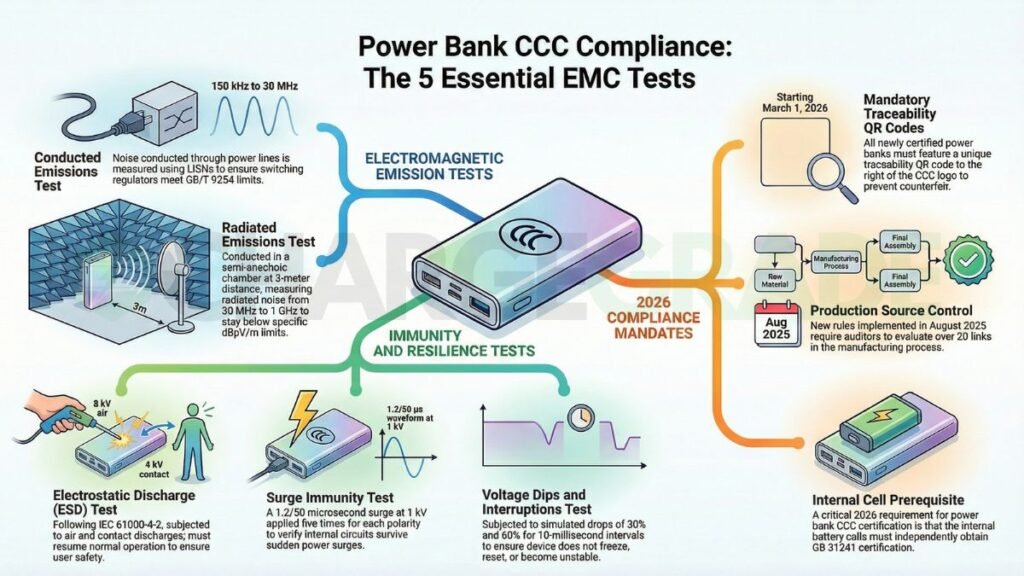
Electromagnetic Compatibility (EMC) Tests
Power banks often contain switching circuits, which can radiate electromagnetic noise.
| Test | Methodology | Purpose |
|---|---|---|
| Conducted emissions | Power bank charged/discharged while LISNs measure line‑conducted noise from 150 kHz – 30 MHz per GB/T 9254 limits. | Keeps switching regulators from polluting AC power lines. |
| Radiated emissions | Measured in semi‑anechoic chamber at 3 m distance, 30 MHz–1 GHz, using broadband antenna. | Ensures radiated noise stays below specified dB µV/m. |
| Electrostatic discharge (ESD) | 8 kV air, 4 kV contact discharges applied to all accessible surfaces (IEC 61000‑4‑2 ref). Device must recover operation afterward. | Prevents malfunctions when touched by static‑charged users. |
| Surge immunity | 1.2/50 µs surge, 1 kV line‑to‑line, applied five times per polarity. | Verifies that sudden power transients don’t harm control ICs. |
| Voltage dips / interruptions | Simulated 30 % and 60 % voltage drops for 10 ms intervals. | Ensures proper recovery without lockups or resets. |
Labelling & Construction Review
A certified power bank must clearly show:
- Rated capacity (mAh/Wh) and voltage/current input‑output values.
- Safety warnings.
- The CCC mark itself.
Any unapproved component change, especially battery cell substitution, voids the certification. Internal construction must follow the tested design, substitution of cheaper cells post‑testing is strictly forbidden.
The CCC Certification Procedure for Power Banks
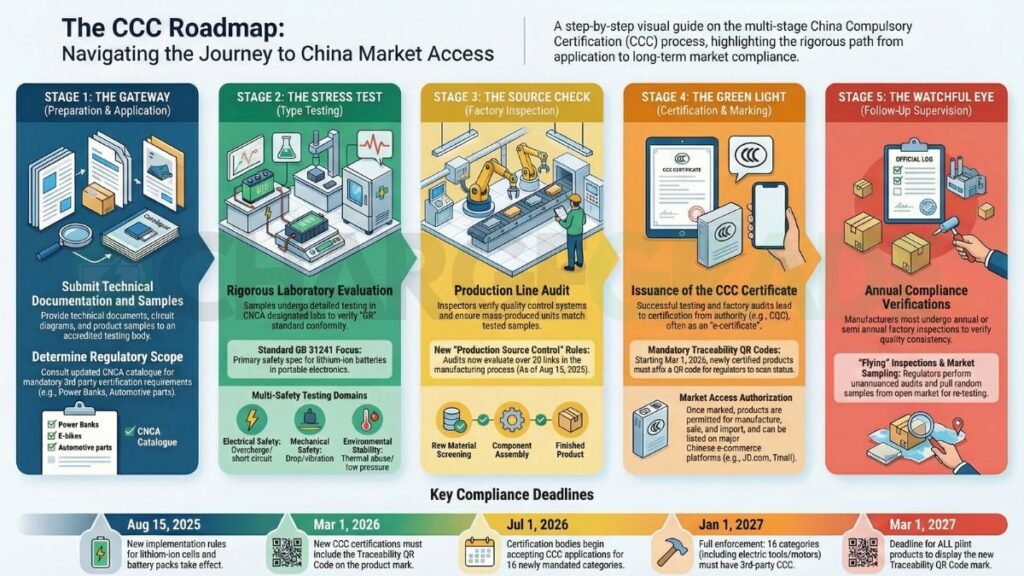
The CCC process isn’t a single test but a multi‑stage approval journey. Each stage validates a different dimension of the product from its underlying engineering to its long‑term reliability.
Step‑by‑Step Breakdown
- Application Submission:
The manufacturer provides technical documents, circuit diagrams, and samples to an accredited testing body. - Type Testing (Product Testing):
Samples undergo detailed laboratory evaluation to ensure conformity to the GB (Guobiao, or “national”) standards, most notably GB 31241, which covers lithium‑ion batteries and battery packs used in portable electronic equipment. - Factory Inspection:
Inspectors audit the production line to confirm that mass‑produced units match the tested samples in quality and safety. - Certification Decision:
If both the testing and the factory inspection are successful, the certifying authority issues the CCC certificate and grants the right to use the CCC mark. - Follow‑Up Supervision:
Annual or semi‑annual factory inspections verify ongoing compliance. Random samples may also be pulled from the market for re‑testing.
What the CCC Actually Means for You
When your power bank carries the CCC logo, it’s already survived a gauntlet of rigorous testing. That means:
- Reduced risk of fires or overheating while charging.
- Stable output for your devices, preventing damage to phones or tablets.
- Reliable internal components that won’t degrade prematurely.
- Minimal interference with wireless devices.
It’s your quiet assurance that “someone has already tried to break this thing safely.”
For everyday travelers and consumers, CCC turns invisible stress tests into visible peace of mind.
Travelling to China With a Power Bank: Will Anyone Check for CCC?
International Flights to and from China are not checked for the CCC label, however if you and transferring to a domestic flight within China, you must have a powerbank with the CCC visible or risk consfiscation.
Generally, the security staff will look for:
- Energy capacity limits:
- Up to 100 Wh (~ 27,000 mAh) —> Freely allowed in carry‑on luggage.
- 100 – 160 Wh —> Allowed only with airline approval.
- Above 160 Wh —> Not permitted on passenger aircraft.
- Carry‑on only: Power banks are never allowed in checked baggage.
- Physical condition: No swelling, cracks, or exposed circuits.
Airport staff may inspect your device or ask to see capacity markings. If they can’t find the capacity label or the bank looks suspiciously unbranded, it may be confiscated. But again, they’re judging safety appearance, not chasing down missing CCC stamps.
When CCC Does Matter During Travel?
| Scenario | CCC Required? | Reason |
|---|---|---|
| Bringing 1–2 devices for personal use | ❌ No | Treated as personal property |
| Carrying several units in luggage | ⚠️ Possible scrutiny | May appear as commercial quantity |
| Selling, importing, or shipping batteries to China | ✅ Yes | Mandatory for trade entry |
So, unless you’re arriving with a suitcase full of power banks, customs officers won’t care about certification stamps, your flight’s safety restrictions take precedence.
Buying a Power Bank Inside China
If you purchase one locally, that’s when CCC matters again. Any legitimate retailer must sell CCC‑certified devices. If you find one without the mark, treat it like an haunted toaster: something might happen, but you don’t want to be around to see it. It ensures that innovation doesn’t outpace responsibility.
Frequently Asked Questions (FAQ)
Is CCC certification mandatory for all power banks?
Yes. Since August 1, 2024, it is illegal to manufacture, sell, or import power banks in China without a valid CCC certificate
Can I use a power bank with CE or FCC marks instead of CCC in China?
For personal use, you can usually travel with CE/FCC marked devices. However, you cannot sell them in China. Furthermore, Chinese airport security prefers the CCC mark; while they often accept clear CE/FCC markings with visible Wh (Watt-hour) ratings, a CCC mark provides the smoothest security clearance.
What happens if my powerbank does not have the CCC?
As of June 28, 2025, CAAC regulations strictly require all power banks carried on domestic flights in China to have a visible China Compulsory Certification (CCC/3C) mark. Power banks without this, or with unreadable labels, face confiscation at security, regardless of capacity (usually limited to 100Wh). This only applies to domestic flights in China. International flights to and from China is unaffected by this rule.
Does the CCC requirement apply to wireless chargers?
Yes, if the device is a “mobile power supply” (has a battery and charges other devices). Pure wireless charging pads (without batteries) may fall under different radio frequency regulations (SRRC), but power banks with wireless charging features require CCC.
How do I know if a CCC mark is real?
Currently, you can check the certificate number under the logo on the CNCA website. Starting in 2026, you will be able to verify it instantly by scanning the mandatory Traceability QR Code next to the logo.
I have an old power bank without CCC. Is it illegal?
It is not illegal for you to own or use it. However, it is illegal for a shop to sell it to you today. Be aware that older, uncertified banks may be scrutinized more heavily at airport security
What is the difference between CQC and CCC?
CCC is mandatory; you must have it to sell the product. CQC is a voluntary certification for products that aren’t on the mandatory list yet. Power banks moved from the voluntary CQC list to the mandatory CCC list in 2023
The Beauty of Compliance
At first glance, certification might seem the opposite of exciting, checklists and standards don’t exactly scream adventure. But dig deeper, and you’ll find it’s the quiet architecture of trust in modern technology. Each certified power bank reflects thousands of engineering decisions, hundreds of hours of testing, and a single promise: that the energy sitting in your pocket behaves predictably.
The next time you reach for that portable battery and spot the CCC mark, know that behind those three simple letters lies a rigorous symphony of safety science, proof that curiosity, regulation, and responsible design can indeed harmonize beautifully.
References
- European Commission, “Access2Markets Barrier: Compulsory Certification System (CCC) Requirements,” Access2Markets, Feb. 02, 2026. [Online]. Available: https://trade.ec.europa.eu/access-to-markets/en/barriers/details?barrier_id=11003.
- State Administration for Market Regulation, “Announcement on the Implementation of Compulsory Product Certification Management for Lithium-ion Batteries and Other Products,” Certification Updates, Mar. 16, 2023. [Online]. Available: https://gma.caict.ac.cn/en/update/212.
- CNCA, “Announcement on the pilot reform of mandatory product certification marks for power banks and other products,” Certification Updates, Dec. 23, 2025. [Online]. Available: https://gma.caict.ac.cn/en/update/212.
- ESTL, “China CCC Mark Pilot Reform: Traceability QR Code Requirements for Power Banks & Electric Bicycles,” ESTL News, Dec. 29, 2025. [Online]. Available: https://en.gdestl.com/659.html.
- ESTL, “Power Bank CCC Certification 2026: New Regulatory Updates & Compliance Guide for China Market,” ESTL Technical Information, Jan. 31, 2026. [Online]. Available: https://en.gdestl.com/709.html.
- CAICT, “Scope definition of CCC certification for newly included products,” GMA CAICT, 2026. [Online]. Available: https://gma.caict.ac.cn/en/update/212.
- CAICT, “Certification Requirements for China | CCC, NAL, SRRC, China RoHS,” GMA CAICT, 2026. [Online]. Available: https://gma.caict.ac.cn/en/regulatory/CN.
- ECQA, “China Compulsory Certificate CCC Guide,” ECQA Blog, Aug. 13, 2025. [Online]. Available: https://ecqa.com/china-ccc-certification-guide/.